
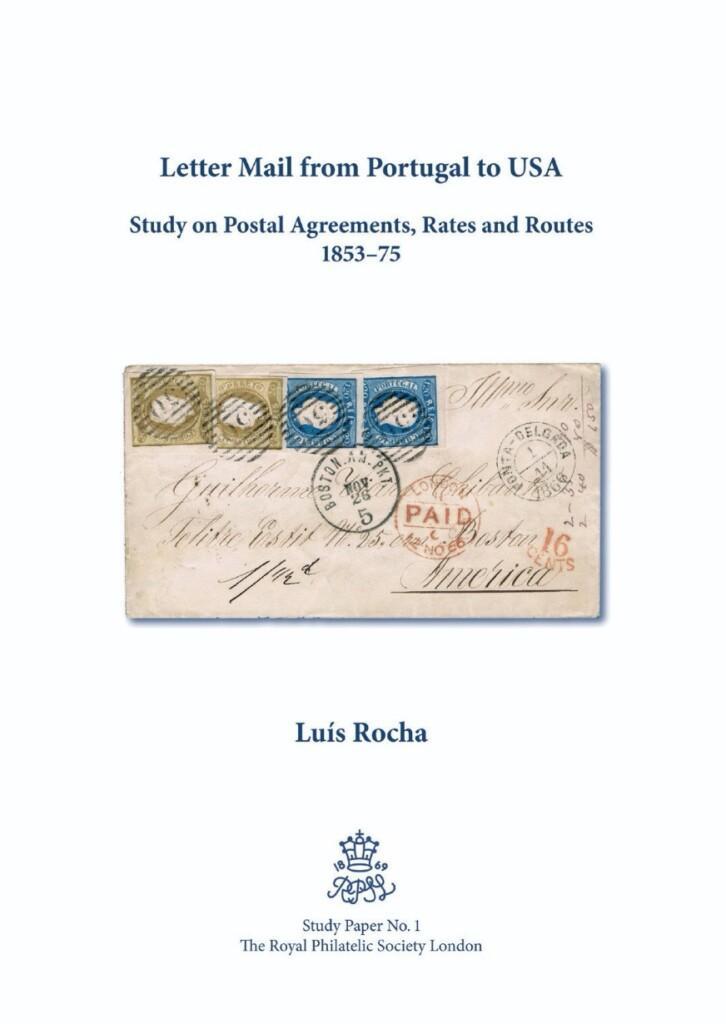
The Royal Philatelic Society London (RPSL) has introduced their first publication in a new series of Study Paper.
This scholarly work analyses the complex postal regulations and procedures for mail sent from continental Portugal, Madeira, and the Azores to the United States of America between the introduction of Portugal’s first adhesive stamps on 1 July 1853 until its entry into the General Postal Union on 1 July 1875. It details how mail transit relied on intermediary countries, primarily the UK, via various Anglo-American postal conventions. The study provides a thorough examination of the different conventions and arrangements to interpret the complex accounting systems, diverse postage rates, and markings found on this transatlantic mail.
The work’s uniqueness lies in its narrow and deep focus. While literature exists on Portuguese, British, and US postal history, this study concentrates specifically on the outbound mail from Portugal and its islands to the USA during this 22-year, pre-UPU period. By excluding alternative routes (e.g. via France, Belgium, Prussia), it provides a highly focused analysis of the dominant role of the British postal system as the transit hub. This allows for a unique interpretation of postal markings by systematically breaking down the complex accounting systems and diverse postage rates under the various Anglo-American and Portuguese-British conventions.
More information on the book, its author, and table of contents can be found on the RPSL website. The cost of this 52-page softbound book is £9.50 for members of the RPSL and £10.50 for non-members (plus postage).